Configuration

Repository configuration
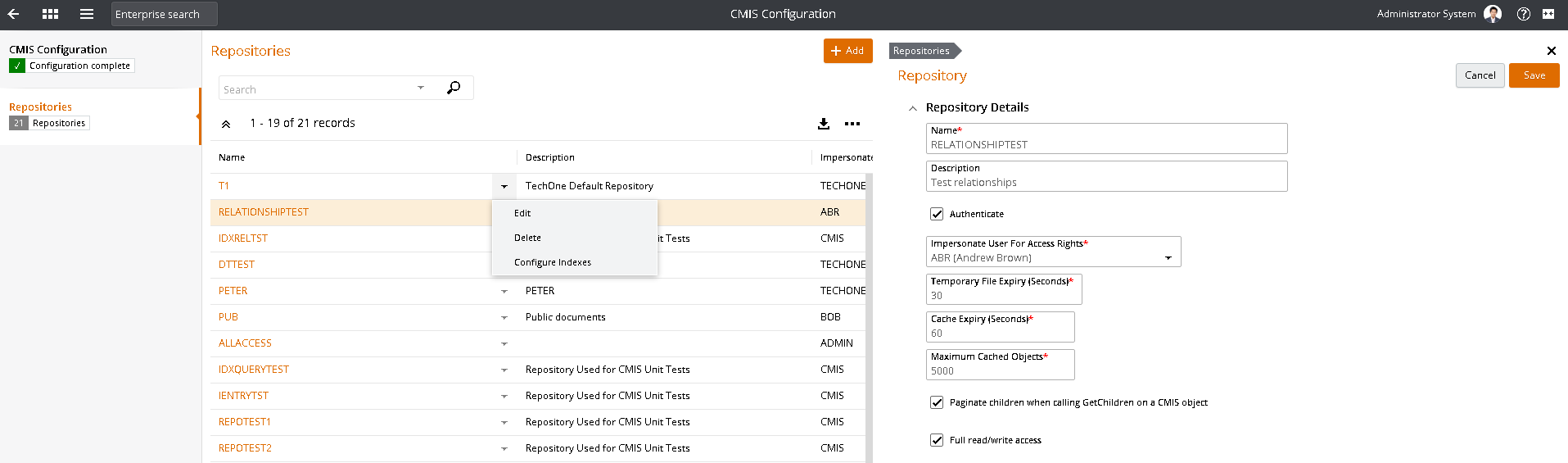
To setup your repository, open CiAnywhere and navigate to the ECM Configuration screen. From here, open the CMIS Configuration screen below.
Important
For security reasons, a separate CMIS repository should be used for each integration and should only have access to the indexes required by the integration. It is also recommended to have a different user for each integration so they can be configured to have just enough security access for the integration to work.
| Name: | Used to uniquely identify a CMIS repository. Note that this value will form part of the url that is used to navigate to this repository. For example, a repository with the name of T1TEST will use a servicedoc url similar to the following:
/[ENVIRONMENT ID]/Api/CMIS/T1TEST/servicedoc |
|---|---|
| Description: | A brief summary that will appear to users who access the repository. |
| Authenticate: | Enabling authentication prevents anonymous users from accessing the repository. In order to access any of the services exposed via CMIS the request will need to contain an authorization header with valid ECM User credentials. |
| Setting the Impersonation User: | |
| The impersonation user is used to determine permissions that the CMIS repository will apply when an authentication user is not available. Logging will also be applied against this user. | |
| Temporary File Expiry: | |
| Temporary files are stored on the server when appending a content stream in chunks via the SetContentStream service. These files will expire if they remain inactive for a duration that exceeds the value configured here. This setting can be utilised to reset a failed upload. | |
| Cache Expiry: | The CMIS data cache is used to store reusable data that is retrieved from ECM. This significantly increases the performance of the application however it may also use a large amount of memory. This setting allows for the cache to be released if it is left inactive. |
| Maximum Cached Objects: | |
| This setting allows for the number of objects stored in the CMIS data cache to be limited. Note that this amount may be temporarily exceeded while processing a single request, however the next call will force a reset. | |
| Paginate Children when Calling GetChildren on a CMIS Object: | |
A single GetChildren call never returns more than 100 results regardless of this setting. When enabled, the response accurately reports hasMoreItems and the total item count, allowing a client to keep incrementing skipCount to page through results beyond the first 100. When disabled, hasMoreItems is always reported as false and the total count as 0, so the client only receives the first 100 results with no indication that more data exists. |
|
Index configuration
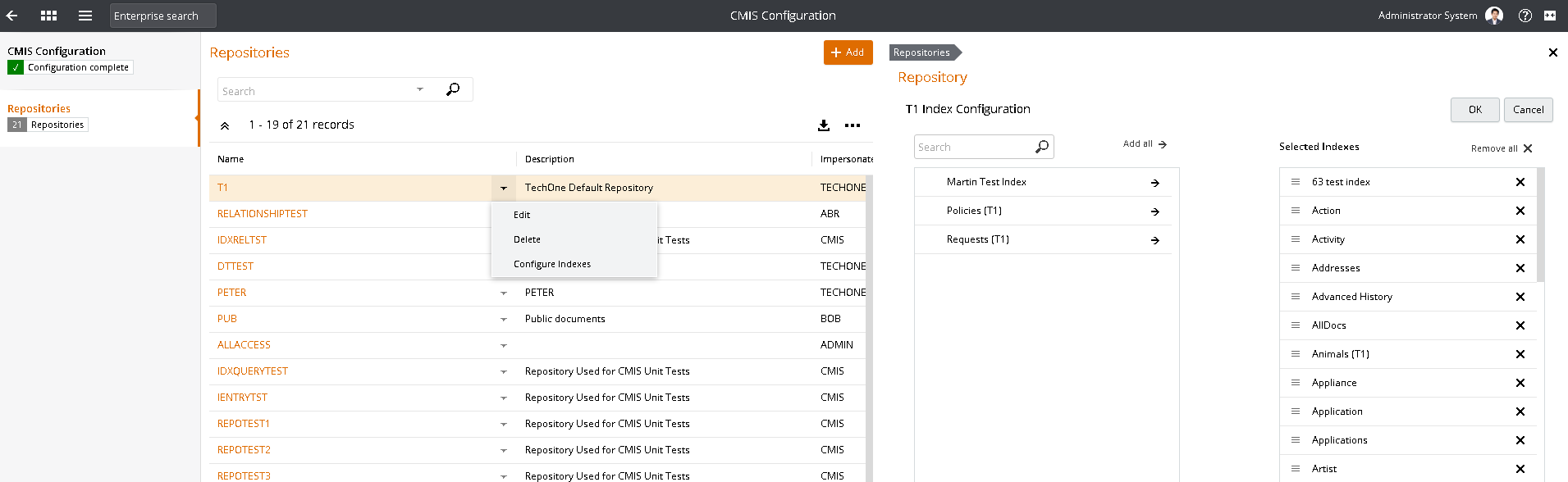
The index configuration screen allows for an additional layer of security to be applied to each repository. The selected indexes section is a whitelist of the indexes that users can access via the repository. Only documents and index entries that are associated with one of the selected indexes are accessible.
Change history configuration
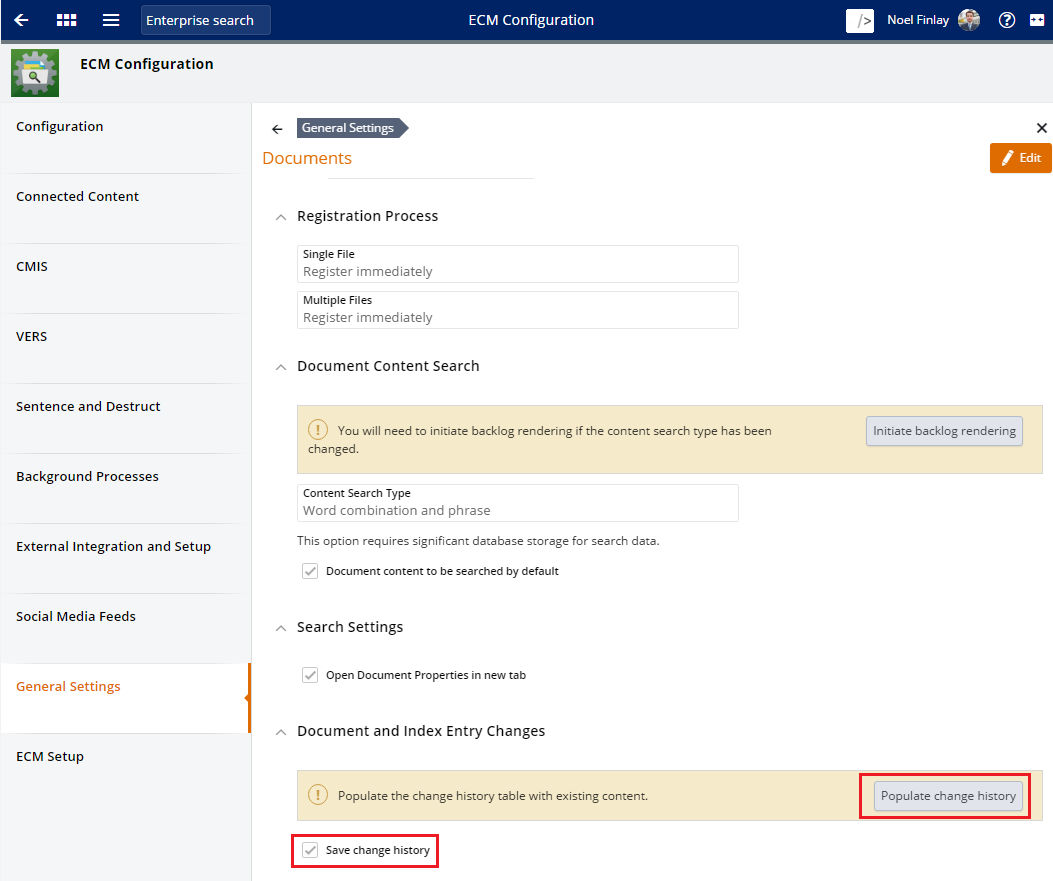
Change history recording can be enabled by checking Save Change History in ECM Configuration under the Documents section. Change events can be generated for all historical records by clicking the Populate Change History button in ECM Configuration screen.